



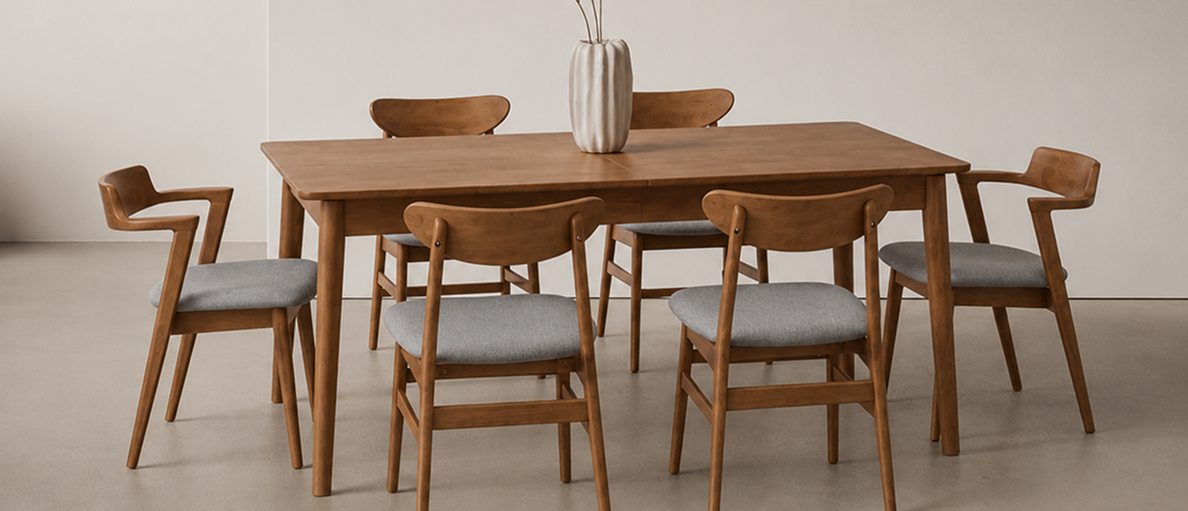
What Makes a Dining Chair Comfortable? 5 Features That Matter
What makes a dining chair comfortable? For longer meals, the most comfortable dining chairs combine the right seat height, supportive cushioning, a gently angled backrest, body-appropriate seat depth, and a stable frame. As a practical starting point, look for a seat around 17–19 inches high, supportive rather than overly soft cushioning, and enough depth to support your thighs without pressing behind your knees.
Comfort matters even more when the dining table is where your household does more than eat. Long dinners, weekend gatherings, homework, coffee, and conversations can keep someone seated for an hour or longer.
Understanding a few basic measurements can make choosing comfortable dining seating much easier. Here are the five factors worth checking before you decide which style or material you prefer.
What Makes a Dining Chair Comfortable? The 5 Key Factors
For a quick reference, these are the five features that have the biggest influence on dining chair comfort:
- Seat height: About 17–19 inches (43–48 cm) works with many standard dining tables. Aim for roughly 10–12 inches (25–30 cm) of clearance between the chair seat and the underside or usable edge of the tabletop.
- Cushioning: Choose cushioning that distributes pressure without letting you sink excessively. For upholstered seating, roughly 1.8–2.5+ lb/ft³ foam density can be a useful durability benchmark, but density describes foam quality and durability more than firmness.
- Back shape: A gently curved backrest that follows the spine and provides lower-back support is usually more comfortable than a completely flat, upright surface. Ergonomics research commonly places supportive seat-to-back angles around 100–110 degrees.
- Seat depth: Around 16–18 inches (41–46 cm) suits many adults. Ideally, there should still be about 1–2 inches of space behind your knees when your back rests against the chair.
- Structural support: A rigid, stable frame, appropriate weight capacity, secure joints, and a seat that distributes weight evenly prevent wobbling and reduce the muscular effort required to remain comfortably seated.
These measurements are useful starting points rather than universal rules. Body height, leg length, table dimensions, upholstery and how long you normally sit all affect the final fit.
1. Get the Seat Height Right
A beautiful dining chair can become uncomfortable quickly if it puts your body at the wrong height relative to the table.
Most standard dining chairs have a seat height of approximately 17–19 inches from the floor. Standard dining tables are commonly around 28–30 inches high, so this pairing generally leaves enough room for your thighs while keeping the tabletop at a natural eating height.
How much space should be between a dining chair and table?
As a practical rule, aim for approximately 10–12 inches between the top of the chair seat and the usable underside or edge of the tabletop.
Too little clearance can leave your thighs cramped beneath the table. Too much can make the table feel unusually high, encouraging you to raise your shoulders or lean forward while eating.
Remember to measure the actual sitting surface of an upholstered chair. Thick seat cushioning compresses once someone sits down.
Before choosing new chairs, compare their measurements with your existing [Dining Tables Collection — /collections/dining-tables] rather than considering chair dimensions alone.
Consider the person using the chair
Your feet should ideally rest comfortably on the floor while your knees remain around hip level or slightly lower. Cornell University's ergonomics guidance similarly recommends a seat position that allows the feet to remain firmly supported.
Petite adults may prefer the lower end of the dining-chair height range. Taller adults may feel more natural on a slightly higher seat, provided there is still enough clearance beneath the table.
2. Look Beyond Softness When Checking Cushioning
People often press a dining chair cushion and assume softer means more comfortable. For longer meals, that isn't necessarily true.
A very soft cushion can feel inviting for the first few minutes but compress too deeply over time. That reduces support and can concentrate pressure rather than distribute it evenly.
Cornell's ergonomics research notes that excessive cushioning can allow the body to sink into the chair and restrict movement. It recommends approximately 1.5–2 inches of cushioning in ergonomic seating as a useful reference point for supportive seat design.
Foam density vs. foam firmness
These terms are often confused.
Foam density describes how much the foam weighs per cubic foot and is primarily related to its construction and durability. Firmness, often measured using ILD or IFD, describes how much force is needed to compress the foam.
Therefore, high-density foam does not automatically mean a hard seat.
For an upholstered dining chair that receives regular use, roughly 1.8 lb/ft³ or higher can be a useful baseline, while foams around 2.0–2.5+ lb/ft³ can offer greater resistance to long-term compression depending on the foam formulation and overall cushion construction.
However, don't judge an upholstered dining chair by density alone. Cushion thickness, foam firmness, webbing or springs beneath the seat, and upholstery all change how it feels.
For homes where spills are inevitable, material maintenance matters too. Review our Upholstery & Fabric Care Guide before choosing lighter fabrics or heavily textured upholstery.
3. Choose a Backrest That Supports Your Natural Posture
The shape of the backrest becomes increasingly important the longer you sit.
A completely straight, flat back may look clean and minimal, but your spine isn't flat. A comfortable chair should provide enough contour to support the lower and mid-back without forcing you into an exaggerated posture.
Cornell's ergonomics guidance identifies a 100–110-degree seat-to-backrest angle as an effective range for seated support. University of New Hampshire ergonomics guidance similarly recommends a backrest that follows the natural curvature of the spine and supports the lumbar and thoracic areas.
For dining furniture, you don't need the adjustability of an office chair. Instead, look for a fixed backrest that creates a subtle recline and feels supportive when you sit naturally.
Curved vs. straight dining chair backs
A gently curved backrest tends to distribute contact across more of the back. It can be especially valuable during long dinners or when the dining area doubles as a place for working or studying.
A straighter back can still be comfortable for shorter meals, particularly when it has good lumbar contouring or upholstery.
If long dinner parties are common in your home, prioritize back shape and seat cushioning before decorative details. Browse our Dining Chairs Collection to see how different upholstered and supportive chair profiles work in modern dining spaces.
4. Match Seat Depth to Your Body
Seat depth is one of the easiest measurements to overlook.
It is generally measured from the front edge of the seat to the point where the seat meets the backrest.
Cornell's chair-design guidance lists approximately 16.5 inches as a recommended fixed-seat depth in ergonomic seating research, while UCLA recommends leaving roughly 1–2 inches between the front of the seat and the back of the knees.
For dining chairs, a practical range is around 16–18 inches, although individual fit matters more than hitting one exact number.
If you're petite
A very deep seat can make it difficult to use the backrest while keeping your feet comfortably supported.
If you have to slide backward to reach the backrest and your feet stop resting naturally on the floor, the chair is probably too deep for you.
Look toward shallower seats around 16–17 inches, depending on your leg length.
If you're tall
Taller users may prefer 17–18 inches or slightly deeper, because a shallow seat may provide insufficient thigh support.
However, deeper is not automatically better. You should still be able to sit fully against the backrest without the front edge pressing into the backs of your knees.
This is why an ergonomic dining chair should be evaluated according to the person using it, not simply whether its dimensions fall within an average range.
5. Don't Ignore Structural Support
Cushions get most of the attention, but the frame underneath them has a major influence on comfort.
A chair that flexes, rocks or shifts slightly under your weight makes your body compensate for that movement. A stable chair lets you settle into a more relaxed seated position.
Check for:
- A rigid frame with secure joints
- Minimal side-to-side movement
- A clearly stated weight capacity where available
- Even leg contact with the floor
- A seat base that distributes weight consistently
- Back support that does not flex excessively
- Reinforced construction around high-stress joints
Wood and metal can both create excellent dining chair frames when properly engineered. Material alone doesn't determine quality; construction and joinery matter just as much.
For households with children or frequent guests, durability should receive extra weight in your decision. Chairs will be pulled out, pushed back, leaned on and moved far more often than occasional-use furniture.
Which Comfort Features Matter Most for Your Home?
Different households should prioritize different features.
For long dinners and entertaining
Focus first on cushioning, back shape and seat depth.
An upholstered seat with resilient cushioning and a gently reclined, supportive backrest helps reduce pressure during extended sitting. A slightly wider seat can also allow guests to reposition themselves naturally.
For growing families
Prioritize frame stability, durable upholstery and practical seat proportions.
Very plush cushioning may require more maintenance, while delicate upholstery can turn everyday spills into unnecessary stress. Consider how easily the surface can be cleaned as well as how it feels.
For small dining rooms
Comfort does not require an oversized chair.
A compact armless design with a supportive curved back can provide good dining chair support without occupying as much visual or physical space. Always check overall chair width and depth, not only seat measurements.
Also confirm that chairs can slide beneath the table when they're not being used.
For petite users
Prioritize moderate seat height and shallower seat depth so the feet remain supported and the back can actually reach the backrest.
For taller users
Look for adequate thigh support, slightly greater seat depth and a sufficiently high backrest. Avoid extremely shallow seats that concentrate pressure around the upper thighs and hips.
Comfort Should Be Tested as a Complete System
Individual specifications are helpful, but no single number guarantees comfort.
A chair with premium foam can still feel awkward if it is too deep. Perfect seat height cannot compensate for a poorly shaped backrest. Likewise, excellent ergonomics will not feel reassuring if the frame wobbles.
Think of the chair, your body and your dining table as one system.
Before buying, check:
Floor → seat height → thigh position → table height → seat depth → backrest support.
That sequence will tell you much more than simply sitting down for ten seconds and deciding whether a cushion feels soft.
If you're buying online, compare the published measurements with a dining chair you already find comfortable. A tape measure can give you a surprisingly reliable reference.
You can also review our Furniture Size Guide and Shipping & Delivery Policy before ordering to confirm dimensions and delivery considerations.
Frequently Asked Questions About Comfortable Dining Chairs
What is the most comfortable seat height for a dining chair?
For many adults and standard dining tables, 17–19 inches (43–48 cm) from the floor to the top of the seat is a practical range. More importantly, aim for roughly 10–12 inches of space between the seat and tabletop area while allowing your feet to rest comfortably on the floor.
Are upholstered dining chairs more comfortable?
Upholstered dining chairs are often more comfortable for longer meals because cushioning helps distribute pressure across the seat and sometimes the back. However, upholstery alone does not guarantee comfort. Seat depth, foam construction, backrest shape, chair height and structural support still determine whether the chair remains comfortable after extended sitting.
What is a good seat depth for a dining chair?
A seat depth of approximately 16–18 inches works for many adults. The best fit leaves about 1–2 inches between the front edge of the chair and the back of your knees while your back remains supported. Petite users often prefer shallower seats, while taller people may benefit from greater depth.
Should a dining chair back be straight or angled?
A slight backward angle is generally more supportive than a rigid 90-degree seat-to-back position for prolonged sitting. Ergonomic seating research commonly identifies approximately 100–110 degrees between the seat and backrest as supportive. For dining chairs, a gentle recline combined with lumbar contouring can provide comfort without creating a lounge-chair posture.
Is firm or soft cushioning better for dining chairs?
Neither extreme is ideal for everyone. Dining chair cushioning should compress enough to distribute pressure but remain supportive enough to prevent excessive sinking. Foam density and firmness are different measurements, so don't judge quality by softness alone. For frequently used upholstered dining seating, resilient foam and a supportive seat foundation are particularly important.
How can I tell if a dining chair will be comfortable online?
Start with measurements. Compare seat height, seat depth, seat width, overall back height and table clearance with a chair you already find comfortable. Then examine the backrest shape, upholstery, cushion construction, frame material and stated weight capacity. Product photography can help with style, but dimensions provide a much better indication of physical fit.
How to Choose What Makes a Dining Chair Comfortable
Understanding what makes a dining chair comfortable comes down to fit and support rather than softness alone. Start with a seat height around 17–19 inches, check for appropriate table clearance, choose cushioning that remains supportive under compression, and look for a gently shaped backrest and seat depth suited to your body.
Then consider how you actually use your dining room.
If dinners regularly turn into two-hour conversations, invest more attention in cushioning and back support. If you're furnishing a busy family dining area, durability and stable construction matter just as much. For smaller rooms, focus on efficient proportions without sacrificing proper seat depth or back support.
Once you know these criteria, comparing dining chairs becomes much easier because you're judging each option on measurable features rather than appearance alone.


