



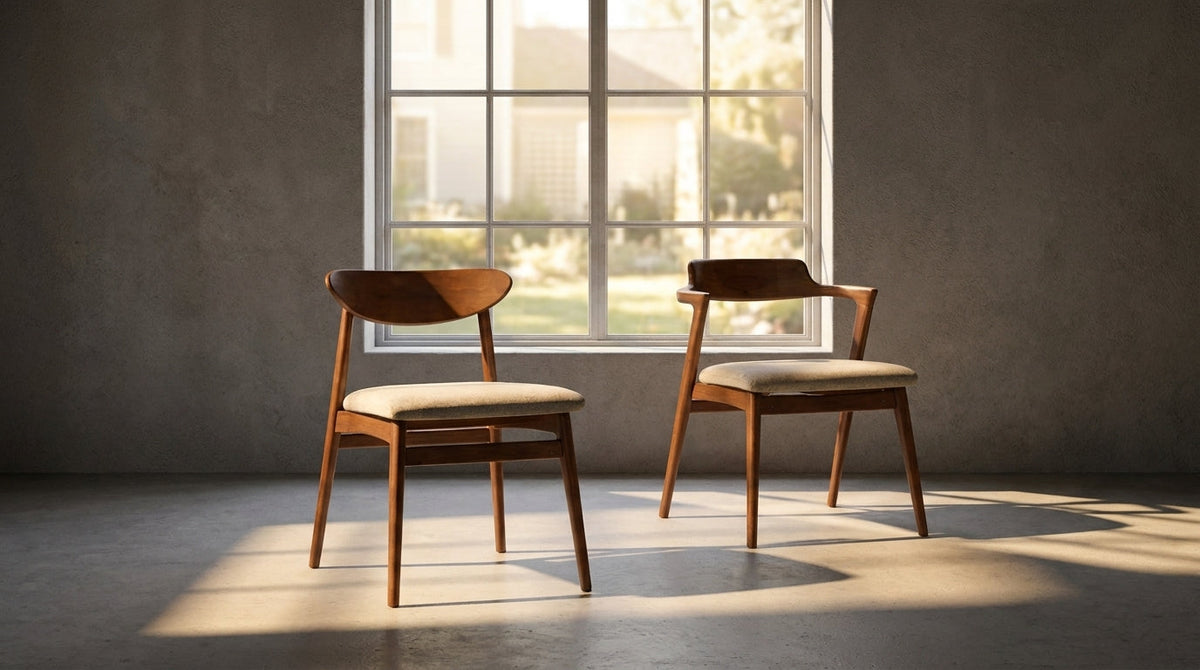
Dining Armchairs vs Side Chairs: Which Should You Choose?
Dining armchairs vs side chairs comes down to space, comfort, and how you use your table. Choose side chairs when you want to maximize seating and keep the dining area open. Choose armchairs for extra support and a stronger presence at the table. For most rectangular dining tables, the best choice is a combination: armchairs at each end and side chairs along the sides.
That mixed arrangement gives you the comfort of dining chairs with arms without sacrificing valuable seating space. It also creates a balanced, intentional dining room layout that works especially well with coordinated collections such as SoftSeason's [Durra Collection — /collections/durra].
Dining Armchairs vs Side Chairs: The Quick Comparison
The main difference is simple: armchairs have armrests, while side chairs are armless. However, those arms affect much more than appearance. They influence how much table space each person needs, whether the chair can tuck under the table, and how comfortably someone can sit through a long dinner.
Side chairs typically range from about 16.5 to 22 inches wide, although upholstered and sculpted designs may be wider.
For a real-world comparison, SoftSeason's Durra Dining Chair measures 22"W × 21.5"D × 30.7"H, while the coordinating Durra Arm Chair measures 22.4"W × 21.7"D × 28.3"H. The difference in overall width is small, but the armrests change how the chair interacts with the table and the person sitting beside it.
| Comparison | Dining Armchairs | Side Chairs |
|---|---|---|
| Space requirements | Usually need more usable width and clearance because of the arms | Easier to place closely together and better for maximizing seating |
| Comfort | More supportive for long meals because guests can rest their arms | Comfortable and easier to move, but offers less upper-body support |
| Table clearance | Armrests must clear the table edge or apron to tuck in fully | No armrest clearance issue, making placement easier |
| Best placement | Head and foot of rectangular tables | Along the sides of rectangular tables or around most round tables |
Best overall choice: Use both if your table and room allow it. A pair of armchairs can frame the table, while side chairs keep the longer sides practical and spacious.
How Much Space Do Armchairs and Side Chairs Need?
Space should be your first consideration because even a beautiful chair becomes frustrating if guests have to squeeze between seats.
A useful starting point is to allow roughly 24 inches of table perimeter per diner. Better Homes & Gardens similarly recommends about two feet of spacing per chair around a rectangular dining table.
However, chair width is only part of the equation. You also need enough room for people to pull chairs back, sit down, and walk behind them.
Choose side chairs when seating capacity matters
Armless dining chairs are usually the easier option for compact dining rooms and tables where you want to fit the maximum number of guests.
Without arms extending beside the seat, people can enter and exit more freely. Side chairs can also sit closer together when necessary.
For example, the Durra Dining Chair measures 22 inches wide. That gives it a supportive, substantial profile while remaining practical for placement along the sides of a dining table.
If you regularly need six or eight seats, prioritize side chairs along the longest edges of the table.
Choose armchairs where you have breathing room
Armchairs work best where there is more open space around the chair, particularly at the ends of a rectangular table.
The Durra Arm Chair is 22.4 inches wide and was specifically designed to sit at the ends of the dining table. Its armrests give the chair a more substantial presence while creating a natural visual anchor for the dining arrangement.
If your dining area is particularly tight, avoid placing armchairs at every position simply for symmetry. You will usually get a more functional layout from two armchairs plus four or more side chairs.
Which Is More Comfortable for Long Meals?
Armchairs are generally the better choice for extended dinners and gatherings because the armrests provide additional upper-body support. They give guests somewhere to rest their forearms between courses and can also make getting into and out of the chair easier.
That does not automatically make side chairs uncomfortable.
Seat cushioning, backrest shape, seat depth, and upholstery can matter just as much as armrests. Ergonomic chairs with supportive curves through the seat and back are particularly useful if your dining table doubles as a place for conversations, games, homework, or working from home. Better Homes & Gardens also recommends prioritizing comfort for dining chairs, especially when people may remain seated for several hours.
The Durra collection takes this approach with sculpted backrests and cushioned seating across both chair styles.
Our recommendation: If your household tends to linger around the table after dinner, include at least two armchairs. If meals are typically quick and maximizing seating matters more, side chairs can comfortably handle most positions.
Table Clearance: Will an Armchair Fit Under Your Dining Table?
This is the measurement buyers most often overlook.
A side chair does not have arms, so the seat and legs are usually the main points you need to check against the table. An armchair adds another measurement: armrest height.
Measure the table apron, not only the tabletop
Many dining tables have an apron or support structure underneath the tabletop. That lower edge determines whether an armchair can actually slide beneath the table.
Before buying dining chairs with arms:
- Measure from the floor to the lowest point underneath the table or apron.
- Measure the chair's armrest height from the floor.
- Compare the two measurements.
Ideally, allow around 1–2 inches of clearance between the top of the chair arm and the lowest obstruction under the table if you want the armchair to tuck underneath comfortably.
Do not assume that a chair will fit simply because its arms appear lower than the tabletop. The apron, brackets, or other structural elements may sit several inches below it.
If the arms cannot pass underneath, the chair will remain farther from the table. That can make a compact dining room feel crowded even when the chair itself is not particularly wide.
This is one reason side chairs are the safer choice when you are mixing chairs with an existing table.
Where Should Armchairs and Side Chairs Go?
For a rectangular dining table, there is a clear winner:
Put armchairs at the two ends and side chairs along the longer sides.
This classic arrangement is sometimes described using terms such as captain's chairs, host chairs, or carver chairs for the armchairs.
There is also a practical reason the arrangement has lasted. End positions usually have more lateral space, while the longer sides need to accommodate multiple people.
SoftSeason uses this exact approach with the Durra Extendable Dining Set, which combines four Durra Dining Chairs with two Durra Arm Chairs.
That 4+2 combination is our recommendation for most six-seat rectangular dining arrangements.
When the table extends, additional side chairs can be introduced without changing the visual structure created by the two end armchairs.
What About Round and Square Dining Tables?
Table shape can change the recommendation.
Round dining tables
For most round tables, choose side chairs.
A round table has no natural "head," so armchairs can make the arrangement feel unnecessarily heavy. Arms may also limit how closely chairs can follow the table's curved perimeter.
Side chairs preserve the open, conversational quality that makes round tables appealing.
For particularly small spaces, round pedestal tables can also provide more usable legroom because there are no corner legs competing with chair placement.
Square dining tables
For four-seat square tables, use four matching side chairs unless the table is unusually large.
Adding one or two armchairs can create an imbalance because there is no obvious end position. If you prefer armchairs, four matching armchairs can work around a generously sized square table, provided there is enough clearance.
Rectangular dining tables
This is where mixing chair types works best.
For six seats, start with:
2 armchairs + 4 side chairs
For eight seats:
2 armchairs + 6 side chairs
This keeps the ends visually grounded while maximizing seating along the longer edges.
Explore SoftSeason's Dining Tables collection if you are choosing chairs and a table together rather than trying to match an existing setup.
Which Chair Type Is Better for a Small Dining Room?
Choose side chairs for a small dining room.
They give you more flexibility, are easier to move, and eliminate armrest-to-table clearance problems. They also make it easier to add another chair temporarily when guests arrive.
Room clearance matters too. Ideally, a dining area should provide enough space behind occupied chairs for someone to sit down and move comfortably. Better Homes & Gardens recommends roughly 42–48 inches between the table and wall when all sides need to remain fully usable.
If you cannot maintain generous circulation space, prioritize armless chairs and avoid oversized host chairs.
For a medium or large rectangular dining room, however, two armchairs usually add comfort without making the room feel crowded.
Can You Mix Armchairs and Side Chairs?
Absolutely. In fact, for many rectangular tables, mixing armchairs and side chairs is more practical than choosing six or eight identical chairs.
The key is to create a relationship between the two styles.
Keep at least two or three elements consistent, such as:
- wood finish
- upholstery colour
- fabric texture
- frame shape
- backrest design
- overall visual scale
That creates variation without making the dining room look pieced together.
Designers also commonly use larger or contrasting chairs at the ends of rectangular tables, while maintaining shared colours, materials, or proportions to keep mixed seating cohesive.
SoftSeason's Durra range makes this particularly straightforward because the armchair and side chair versions share the same design language and are available in coordinating finishes.
A Simple Formula for Choosing Your Dining Chairs
If you are still comparing options, use this rule:
Small room + maximum seating needed: Choose side chairs.
Large rectangular table + frequent entertaining: Choose two armchairs at the ends and side chairs along the sides.
Long dinners + comfort is the priority: Include armchairs.
Round or compact square table: Choose matching side chairs.
Want a more layered, designer-led dining room: Mix two coordinating armchairs with matching side chairs.
Also consider how often your seating requirements change. An extendable table paired with side chairs gives you the easiest way to increase capacity for holidays and gatherings.
SoftSeason's Durra dining collection follows this flexible approach. The complete Durra set includes four side chairs and two armchairs, while additional coordinating chairs can be added as needed.
Dining Armchairs vs Side Chairs FAQ
Are armchairs or side chairs better for a dining table?
Side chairs are better when space and seating capacity are priorities, while armchairs are better for additional support and comfort. For a rectangular dining table, the strongest all-around setup is usually two armchairs at the ends with side chairs along the longer sides. This balances comfort, capacity, and visual proportion.
How much space should you leave between dining chairs?
Plan for approximately 24 inches of table space per person as a practical starting point. Wider upholstered chairs may need more. Always measure the actual chair width and consider elbow room rather than relying only on the table's advertised seating capacity. Crowding too many chairs around a table makes both dining and movement uncomfortable.
Do dining chair arms need to fit under the table?
They do not have to, but armchairs are easier to use in compact rooms if they can tuck beneath the table. Measure from the floor to the lowest point of the table apron and compare it with the armrest height. Aim for roughly 1–2 inches of clearance to avoid contact.
Should armchairs go at the head of the dining table?
Yes. On a rectangular table, placing armchairs at the head and foot is usually the most practical arrangement. These positions provide more room around the chair and let the armchairs visually frame the table. Side chairs can then maximize capacity along the longer sides without creating unnecessary crowding.
Can you use all armchairs around a dining table?
Yes, but we recommend it only for generously sized tables and dining rooms. Armchairs require more usable space around each diner and may not tuck completely under every table. For most six- or eight-seat rectangular tables, two armchairs combined with side chairs provide better flexibility and a lighter visual balance.
How do I know how many dining chairs will fit my table?
Start by allowing approximately 24 inches of table perimeter per diner, then check the actual width of your chosen chairs. Table legs, pedestals, and armrests can reduce usable seating space. For extendable tables, measure both configurations because the extended setting may allow two or more additional side chairs.
Dining Armchairs vs Side Chairs: Our Recommendation
For most buyers comparing dining armchairs vs side chairs, we recommend a combination rather than choosing exclusively between them.
Use two armchairs at the ends of a rectangular dining table and side chairs along the sides. You get extra comfort where there is room for it, preserve seating capacity where space is tighter, and create a dining arrangement that feels balanced from every angle.
If your dining room is small or your table is round, choose side chairs instead. They are easier to position and give you greater flexibility.
For a coordinated version of the mixed-chair approach, explore the [Durra Collection — /collections/durra], where matching armchairs, side chairs, extendable tables, and dining sets are designed to work together.


